
ONBOARDING ORCHESTRATION
LAUNCHPATH
A calm operating system for work that begins before day one and continues long after it.
- ROLE
- Product design
Full-stack implementation - SCOPE
- Product UI · server actions
Data model · access + business rules · tests · deployment - AUDIENCE
- Operations and people teams
Managers and task owners - PERIOD
- 2026 iterations
Deployed prototype - STACK
- Next.js 16React 19TypeScriptPostgreSQLSupabase
- CONSTRAINT
- Business-day scheduling
Tenant-safe history - CONTEXT / RESULT
- Portfolio product
Deployed prototype - CODE
- Private repository
Architecture documented





Snapshots, scheduling and isolation at a glance.
Role and scope are stated above. This index isolates the system boundary, the mutable-state problem, the decision and its proof.
- ARCHITECTURE
- Server actions → scoped queries → PostgreSQLSession, organization and role are rechecked before every mutation.
- HARD PROBLEM
- Templates change while journeys runAn edit must not rewrite the plan already assigned to a person.
- KEY DECISION
- Snapshot the plan at launchTemplate name and ordered steps become independent journey and task rows.
- PROOF
- Copied state is inspectedDatabase tests read 3 copied tasks and the copied template name.
01 / THE OPERATIONAL GAP
A copied checklist cannot run a living process.
Each onboarding lived in a different copy: unclear deadlines, manual reminders and no shared view of progress.
I built one simple rule: define the path once, launch it for each person, then make owners, business-day dates and delays visible.
02 / THE SCHEDULING ENGINE
Relative intent becomes a real calendar.
Each template step stores an owner and an offset. At launch, one pure function calculates dates in business days from the arrival date.
START DATE + BUSINESS-DAY OFFSET = SHARED DUE DATE
03 / THE WORKING JOURNEY
Progress reads like a path, not a spreadsheet.
Numbered folios expose position, overdue states make delay explicit and the activity history preserves who changed what.
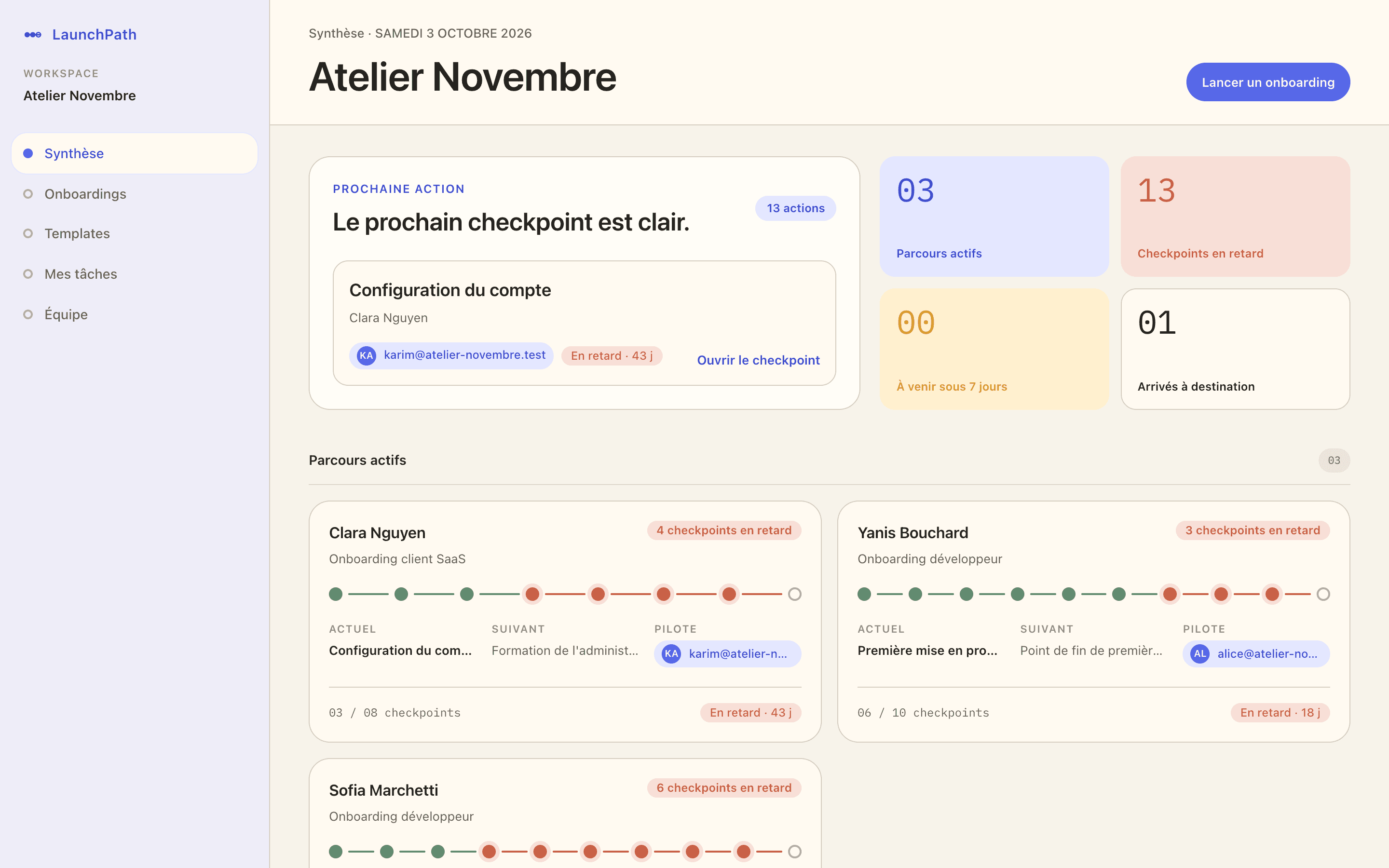
The dashboard surfaces the next checkpoint, active journeys and delays before the team opens a single record.
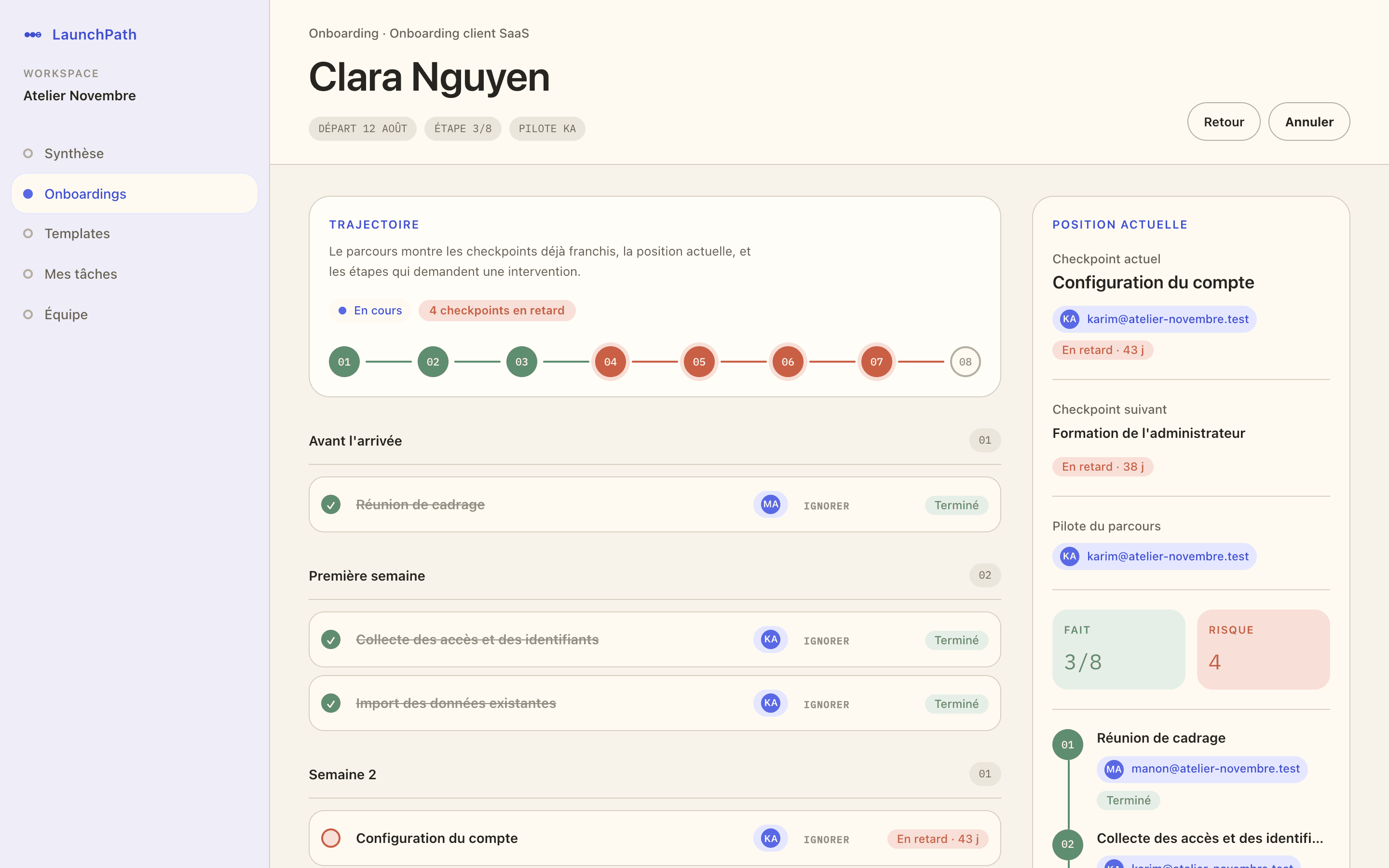
The trajectory, owners and business-day deadlines remain visible together, so the team can act without reconstructing context.
04 / ENGINEERING DECISION
Launch copies the plan instead of linking to it.
- 01
PROBLEM
A mutable template must not rewrite an onboarding already underway or erase the name it started from.
- 02
CHOICE
At launch, the template name and ordered steps are copied into the journey and its tasks, with assignees and computed due dates.
- 03
WHY
Each running journey becomes an independent snapshot; later template edits only affect future launches.
- 04
TRADE-OFF
Template fixes do not propagate automatically to active journeys and must be applied explicitly when needed.
TECHNICAL PROOFS
Three rules. Three inspectable checks.
Each card points to an exact expectation or implemented path confirmed in the source repository.
- A / UNIT TEST
The weekend is skipped
- CLAIM
- Friday 13 Mar 2026 + 1 business day must land on Monday
- MECHANISM
- addBusinessDays() advances through civil dates and counts Monday to Friday
- PROOF
- scheduling.test.ts expects Monday 16 Mar 2026
- B / DATABASE TESTS
A launch becomes a snapshot
- CLAIM
- A journey must keep the plan used at launch
- MECHANISM
- The transaction copies the template name and ordered steps into journey + task rows
- PROOF
- Integration tests read 3 copied tasks and the copied template name
- C / DATABASE TEST
Organization isolation holds
- CLAIM
- Organization A submits Organization B’s task ID with status = done
- MECHANISM
- findOwnedTask() requires both the task ID and current organization ID
- PROOF
- Integration test: the action is ignored; Organization B’s task remains todo
05 / TRUST BOUNDARIES
Multi-tenant by construction.
Every mutation rechecks the session, organization and role.
The browser never reaches business data directly: deny-all RLS below, one verified server path above.
06 / QUALITY AS PRODUCT BEHAVIOR
181 passing cases. Three levels of confidence.
181 counts individual passing test cases across three commands, not 181 user journeys: 91 unit cases, 86 database integration cases and 4 browser journeys.
Source: private LaunchPath repository · pnpm test / test:db / test:e2e · verified 10 Oct 2026 · 0 failures
Dates, scheduling, session and redirect safety.
Real constraints, snapshots and tenant isolation.
Critical flow and responsive behavior in Playwright.
The hardest bugs were not visual.
A risky migration, a premature UI refresh and a falsely green test each became a stronger boundary and a more honest verification path.
07 / WHAT THIS PROJECT PROVES
I can design the journey
and engineer its reliability.
Workflow, interface, business rules, data boundaries and verification were designed as one product system.
- 01PRODUCT MODEL
Turn a scattered process into explicit rules
Templates, owners, offsets and statuses replace copied documents.
- 02INTERACTION DESIGN
Keep the next action visible
Folios, phases, URL-driven detail and history preserve context.
- 03BUSINESS LOGIC
Encode time as a product rule
One pure function handles positive and negative business-day offsets.
- 04DATA & SECURITY
Make isolation impossible to forget
Scoped queries, verified memberships and deny-all RLS protect every path.
- 05DELIVERY QUALITY
Test the promises teams depend on
Unit, database and end-to-end tests cover critical behavior.
08 / OUTCOME
Operational clarity, encoded.
LaunchPath demonstrates reusable templates, business-day scheduling, collaboration and tenant-safe data access in one product system.
Assignment emails and the secured, idempotent reminder endpoint are implemented. Automatic production scheduling and delivery monitoring are not configured in this repository yet.
- IMPLEMENTED
- Assignment emailsSent after launch and reassignment, outside the data transaction.
- IMPLEMENTED
- Reminder engineA secured endpoint handles due-soon and overdue emails without duplicate sends for the same day.
- TO CONFIGURE
- Production schedulerConnect and monitor a daily trigger before presenting reminders as an automated production service.
09 / THE NEXT PILOT
Validate the path
before automating more.
The next useful release is not another feature. It is a measured pilot with operations teams that proves the model makes ownership clearer and delays easier to act on.
- 0101 / OBSERVE
Run real onboardings
Follow a small cohort from template authoring to the final activity event.
- 0202 / MEASURE
Compare delays and ownership
Measure overdue-task reduction and how quickly an owner can identify the next action.
- 0303 / DECIDE
Connect only proven automation
Schedule the existing reminder endpoint, then add integrations only where the pilot shows repeated manual work.